

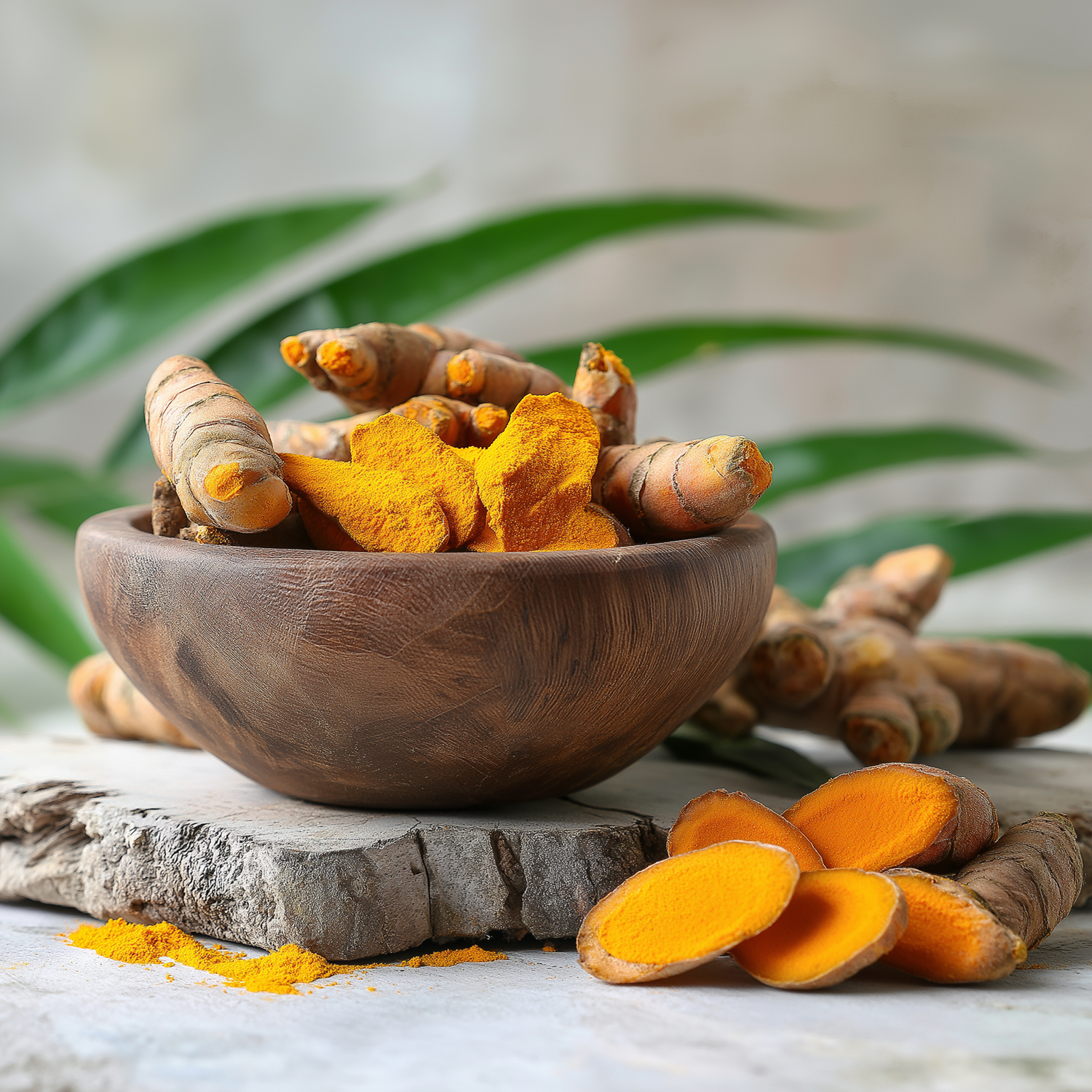
Turmeric (Curcuma longa)
Curcuma, also called turmeric, is a tropical plant from the ginger family (Zingiberaceae).
The bright yellow root tuber has been used for thousands of years in South and Southeast Asia both as a spice and in Ayurvedic and traditional Chinese herbal medicine.
Botanical characteristics
- Botanical name: Curcuma longa
- Family: Zingiberaceae (ginger family)
- Growth form: Perennial, herbaceous plant
- Leaves: Large, lanceolate, alternate
- Rhizome: Yellow to orange colored root tuber, which is dried after harvest and
processed into powder or extracts
Ingredients
The turmeric root contains a variety of secondary plant substances, including:
- Curcuminoids (curcumin, demethoxycurcumin, bisdemethoxycurcumin)
- Essential oils (including Turmeron, Atlanton)
- Bitter substances, resins and polysaccharides
Important NOTE:
There are currently no approved health claims for curcumin according to EU Regulation (EC) No. 1924/2006.
Traditional use
In traditional Asian herbal medicine, turmeric has been used for centuries as a component of the daily diet and in Ayurvedic practice.
These instructions are based on traditional use and are not equivalent to officially approved health claims.
Modern Use & Bioavailability
The absorption (bioavailability) of curcumin from conventional turmeric powder is comparatively low.
Therefore, modern formulations are being developed to improve absorption, such as:
- Micellar technology
- liposomal preparations
- Combination with certain dietary fats
Scientific studies
Curcumin is one of the most intensively studied plant compounds worldwide. Examples of studies include:
- Foods (2017): “Curcumin: A Review of Its Effects on Human Health”
- Molecular Nutrition & Food Research (2014): “Enhanced bioavailability and anti-inflammatory efficacy of curcumin”
These publications are intended for scientific classification and do not permit any health-related advertising claims.
Research on NovaSOL®
NovaSOL® technology is a special micellar formulation for curcumin. Studies report the following benefits compared to conventional curcumin powder:
- up to 185-fold higher bioavailability (AUC 0–24 h)
- up to 453 times higher maximum blood concentration (Cₘₐₓ)
- significantly shortened absorption time (approx. 1 h instead of 7.5 h)
These results refer exclusively to the tested NovaSOL® formulation . They do not represent a general health claim .
Instructions for use
- Food supplements containing turmeric are food and not a substitute for a balanced diet.
- If you are taking anticoagulant medication at the same time, you should seek medical advice.
Dietary supplement with curcuma (advertisement)
👉 Curcumin Liquid – Liquid Curcumin with NovaSOL®
Per daily dose: 500 mg turmeric preparation, of which 30 mg curcuminoids.
A notice:
Dietary supplements are not intended to prevent, treat, or cure any disease. The information provided is based on traditional use and general scientific knowledge. Consult a healthcare professional if you are unsure.
Frequently Asked Questions (FAQ)
What is the difference between turmeric and curcumin?
Curcuma is the plant, curcumin is one of its main ingredients.
Is “turmeric” the same as curcuma?
Yes, they are just different spellings.
How can recording be improved?
Through modern formulations such as micellar technology (e.g. NovaSOL®) or taking it together with some fat.
Is turmeric suitable for everyone?
If you have certain pre-existing medical conditions or are taking medication, you should seek medical advice.
Are there approved health claims?
No, not currently.
Legal notice
This article is intended solely to provide general information about herbal ingredients and is based on scientific literature and traditional use.
Dietary supplements are food products. They are not a substitute for a balanced diet and are not intended to treat, cure, or prevent any disease.
Transparency notice
The products mentioned in this article refer to products from our own range. We generate revenue from the sale of these products. Disclosures are in accordance with Section 5a of the German Unfair Competition Act (UWG) and Section 3 of the German Commercial Code (HWG).
The plant images used in this article are symbolic representations. They were created with AI support and are for illustrative purposes only. Deviations from the natural representation are possible.
