

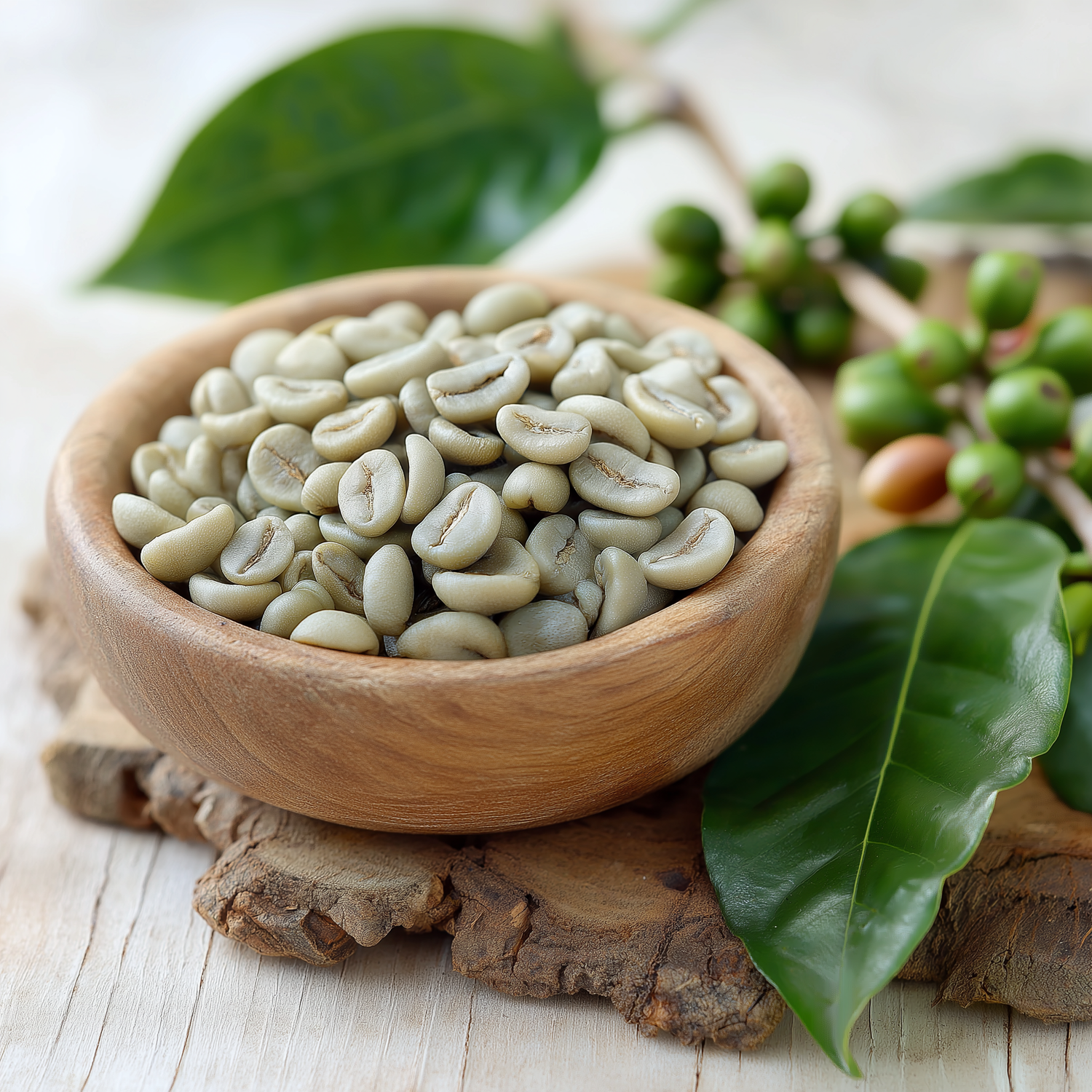
Green coffee bean extract (Coffea arabica / Coffea canephora)
Green coffee beans are the unroasted seeds of the coffee plant, usually of the Coffea arabica and Coffea canephora (Robusta) species. Because they are not roasted, certain components—particularly chlorogenic acids—are retained to a greater extent than in regular coffee. Green coffee bean extract is now used in dietary supplements and is independent of traditional coffee consumption.
Botanical characteristics
The coffee plant belongs to the madder family (Rubiaceae).
- Growth form: Evergreen shrub or small tree
- Leaves: Dark green, glossy
- Flowers: White, fragrant
- Fruits: Red stone fruits with two seeds – the coffee beans.
For extracts, the beans are harvested before they are roasted.
Ingredients
Green coffee bean extract contains among other things:
- Chlorogenic acids (secondary plant substances)
- Caffeine (naturally present, varies depending on the extract)
- Trigonelline (an alkaloid)
- Polyphenols
Traditional use
In some regions of Africa and Arabia, green coffee beans were traditionally used as an infusion.
Green coffee played no historical role in European medicinal plant traditions. Its use as a dietary supplement is a modern development.
Modern use (advertising)
Our product Vergelip uses a standardized extract from green coffee beans with a defined chlorogenic acid content.
Dietary supplement – not a drug. Not intended to treat, cure, or prevent any disease.
Scientific studies (general information)
The following studies are for scientific information purposes only and should not be interpreted as medical claims:
Shimoda H. et al. (2006)
“Green coffee bean extract and its metabolite chlorogenic acid reduce visceral fat accumulation in mice” BMC Complementary and Alternative Medicine
Thom E. (2007)
“The effect of chlorogenic acid enriched coffee on glucose absorption in healthy volunteers”. Journal of International Medical Research
Soga S. et al. (2013)
“Effects of coffee intake on blood pressure, body weight and lipid profile” Hypertension Research
These studies are intended solely for general scientific information and do not constitute health claims within the meaning of the EU regulation.
Instructions for use
- Food supplements do not replace a balanced and varied diet
- Not suitable for children, pregnant women and breastfeeding women
- People with caffeine sensitivity or cardiovascular disease should seek medical advice
Frequently Asked Questions (FAQ)
What is green coffee bean extract?
An extract from unroasted coffee beans, usually Coffea arabica or Coffea canephora , with a higher content of chlorogenic acids than roasted coffee.
Does it contain caffeine?
Yes, naturally. The caffeine content is often lower than in roasted coffee, but decaffeinated versions are also available.
Is it consumed as a beverage?
Traditionally in some cultures yes, but in the West predominantly as
Dietary supplement.
Does green coffee bean extract help with weight loss?
There are currently no approved health claims regarding a weight-reducing effect.
Are there any side effects?
Depending on the caffeine content, high doses can cause restlessness, palpitations, or sleep problems.
Legal notice
This article is for general information purposes only and does not replace medical advice.
No health claims are made beyond the approved formulations in accordance with EU Regulation (EC) No. 1924/2006.
Dietary supplements are food products and are not intended to treat, cure, or prevent any disease.
Transparency notice
The product links lead to our own shop. If a purchase is made there, we receive compensation. This notice is provided in accordance with the legal requirements of Section 5a of the German Unfair Competition Act (UWG) (Duty of Transparency) and Section 3 of the German Medicines Advertising Act (HWG).
The plant images used in this article are symbolic representations. They were created with AI support and are for illustrative purposes only. Deviations from the natural representation are possible.
