

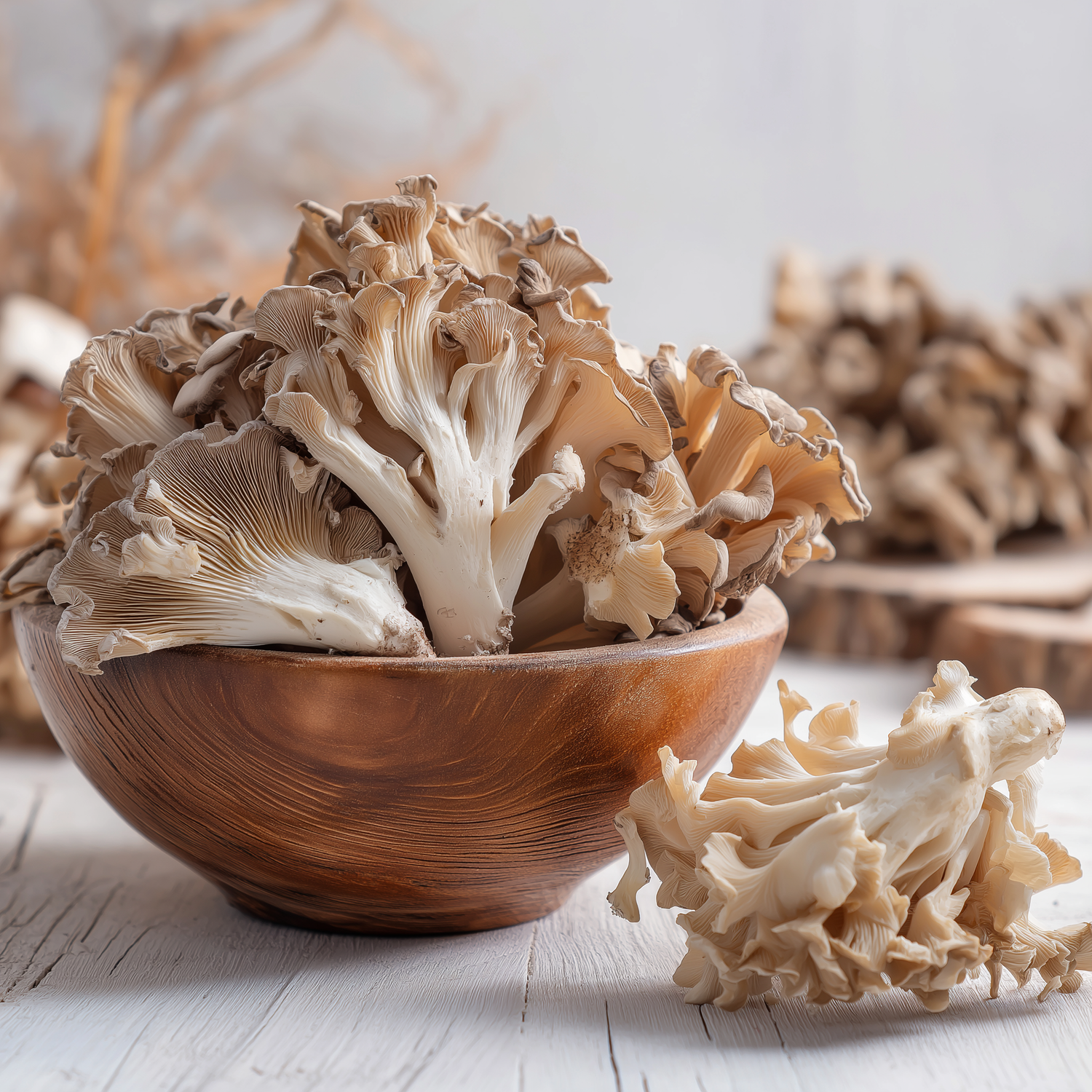
Maitake (Grifola frondosa)
The maitake (Grifola frondosa) is a medicinal mushroom from the Sparassoidaceae family. It has been valued in traditional Asian botany for centuries. Its Japanese name means "dancing mushroom"—according to legend, people would dance for joy upon finding it. In Europe, it is also known as the tinder fungus.
Botanical characteristics
- Prefers to grow at the base of deciduous trees, especially oaks
- Forms large, cluster-shaped fruiting bodies with many fan-shaped, grey-brown caps
- Both fruiting bodies and mycelium are processed in food supplements
Ingredients
Maitake contains among other things:
- Beta-glucans (polysaccharide compounds)
- Other polysaccharides such as Grifolan
- Ergosterol (precursor of vitamin D2)
- Amino acids, minerals and B vitamins in small amounts
Beta-glucans in particular are the focus of scientific research.
Traditional use
In Chinese and Japanese tradition, Maitake was used to generally strengthen the body and as a tea or powder.
This information is based on traditional knowledge and does not constitute approved health claims.
Modern use (advertising)
Today, Maitake is used in many dietary supplements, often in combination with vitamins or trace elements.
Example from our range: Beta-D-Immun contains per daily dose (3 capsules):
- 220 mg Maitake powder
- 48 mg vitamin C
- 52.2 mg zinc gluconate
- 1.5 mg astaxanthin
Dietary supplement – not a medicine.
Scientific studies (general information)
These studies are intended solely for general scientific information and not as health advertising:
- Zhuang C et al. (2012): Immunomodulating effects of beta-glucans from Maitake mushrooms. Int J Med Mushrooms.
- Kodama N. et al. (2003): Effect of Maitake D-fraction on the activation of NK cells in cancer patients. J Med Food.
- Adachi Y et al. (1994): Characterization of beta-glucans from Grifola frondosa and their antitumor activity. Biol Pharm Bull.
Instructions for use
- Food supplements are not a substitute for a balanced diet
- Not intended to treat, cure or prevent any disease
- If you have chronic illnesses, autoimmune diseases or are pregnant or breastfeeding, seek medical advice
Frequently Asked Questions (FAQ)
Is Maitake a medicinal mushroom?
The term “medicinal mushroom” is not legally protected and may not be used in a health-related context.
Does Maitake affect the immune system?
Beta-glucans from maitake are being scientifically studied. However, there are no approved health claims for maitake itself.
Are there any side effects?
In rare cases, allergic reactions may occur. People with mushroom allergies should be cautious.
Is Maitake vegan?
Yes, provided the capsule shell is also plant-based (e.g. cellulose).
Fruiting body or mycelium – which is better?
Fruiting bodies usually contain higher levels of beta-glucans and are used preferentially.
Legal notice
This article is for general information purposes only and does not replace medical advice.
No health claims are made beyond the approved formulations in accordance with EU Regulation (EC) No. 1924/2006.
Transparency notice
The product links lead to our own shop. If a purchase is made there, we receive compensation. This notice is provided in accordance with the legal requirements of Section 5a of the German Unfair Competition Act (UWG) (Duty of Transparency) and Section 3 of the German Medicines Advertising Act (HWG).
The plant images used in this article are symbolic representations. They were created with AI support and are for illustrative purposes only. Deviations from the natural representation are possible.
