

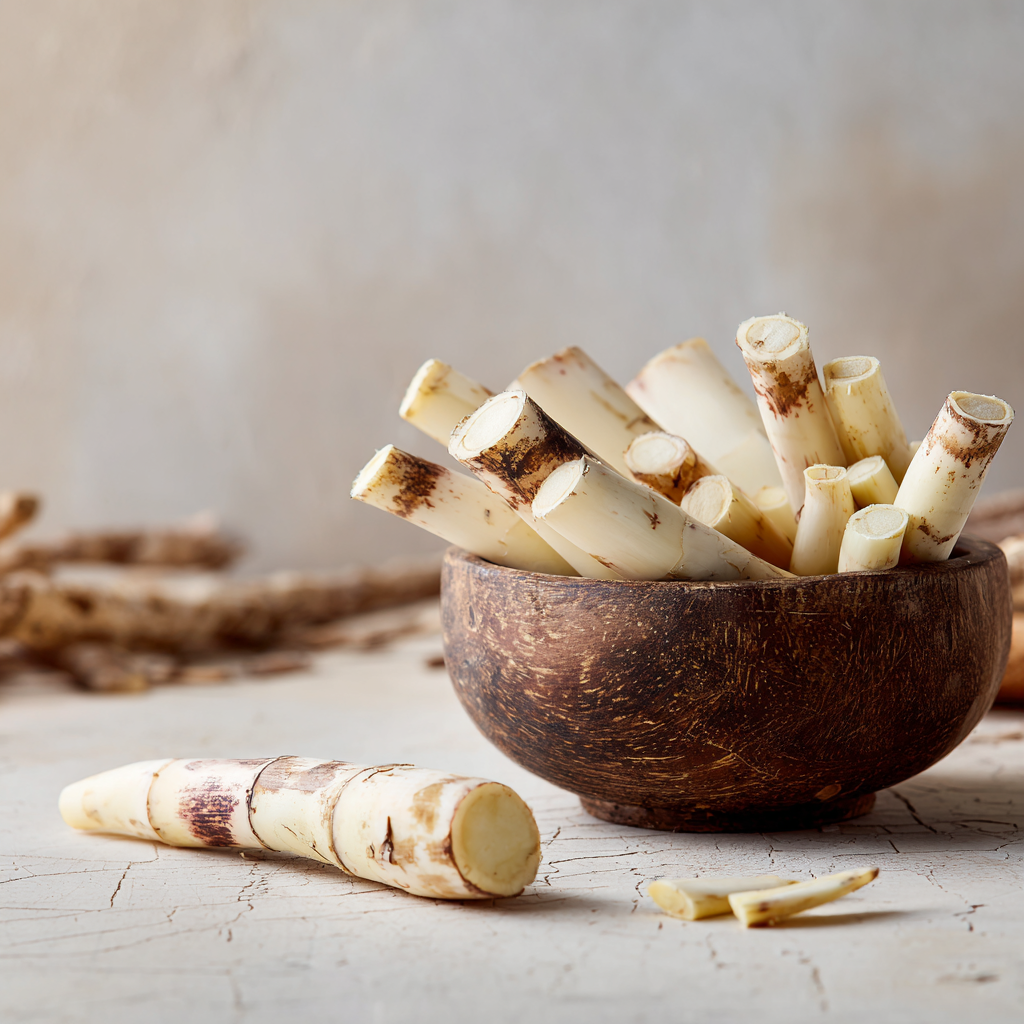
Bamboo (Bambusa vulgaris)
Bamboo is one of the fastest-growing land plants—some species can grow up to one meter per day. Although it is often colloquially referred to as the "bamboo tree," it is botanically a woody sweet grass.
In Asia, the young shoots are traditionally used both as food and in botanical science. Bamboo extract is now important in dietary supplements, primarily due to its content of plant-bound silicon.
Botanical characteristics
- Botanical name: Bambusa vulgaris
- Family: Poaceae (grasses)
- Growth form: Perennial, woody grasses with hollow stems and distinct nodes
- Leaves: Narrow, lanceolate, alternate
- Distribution: Originally from tropical and subtropical regions of Asia, now cultivated worldwide
- Special feature: Some species only bloom at very long intervals (30–120 years)
Ingredients of the plant
Bamboo shoots contain, among other things:
- Plant-bound silicon (e.g. in the form of silicic acid derivatives)
- Amino acids such as arginine, glutamine and serine
- Polyphenols such as ferulic acid
- Flavonoids
- Fiber
A notice:
There are currently no EU-approved health claims for silicon. Therefore, health-related advertising is not permitted.
Traditional use
Bamboo has been used as a food in Asia for centuries. In traditional applications, the shoots were also considered a source of plant minerals. In Europe, bamboo extract is mainly used in dietary supplements.
Origin and processing
For high-quality extracts, young bamboo shoots are harvested from controlled cultivation, primarily in India and China. After harvesting, they are gently dried and extracted to concentrate their natural silicon content.
Cultivation
Bamboo is considered a sustainable raw material source: It grows extremely quickly, absorbs carbon dioxide, requires little pesticide use, and can be harvested multiple times a year. Many producers also pay attention to resource-efficient cultivation methods and fair supply chains.
Research and literature
Research on bamboo focuses primarily on its silicon content.
- Jugdaohsingh et al. (2004), Arch Dermatol Res – Investigations on silicon preparations in the context of dermatological issues
- Seaborn & Nielsen (2002), J Trace Elem Exp Med – Discussion of silicon in relation to bone metabolism
- Carlisle (1980), Science – early evidence of silicon and skeletal development
A notice:
These studies are provided for scientific purposes. They do not constitute approved health claims within the meaning of EU Regulation (EC) No. 1924/2006.
Food supplement with bamboo (advertisement)
👉 Skin Hair Nails – Herbal combination with bamboo, pearl millet and
squirrel
Per daily dose (2 capsules):
- 720 mg bamboo shoot extract (of which 540 mg silicon)
- 200 mg pearl millet seed extract
- 100 mg squirrel extract (of which 30 mg polysaccharides)
Special features:
- Vegan
- Gluten-free
- Lactose-free
- Free from artificial colors
- According to law, no preservatives
A notice:
This product is a dietary supplement and not a medicinal product. The information is based on traditional use and scientific literature, not on approved health claims.
Frequently Asked Questions (FAQ)
What is special about silicon from bamboo?
It is present in plant-bound form and is a component of the natural plant matrix.
Are there approved health claims for bamboo or silicon?
No, there are currently no EU-approved health claims for bamboo or silicon.
Is bamboo safe in dietary supplements?
Bamboo shoots are considered a traditional food. High-quality extracts come from controlled production processes.
How is bamboo extract taken?
In capsule or powder form, usually with liquid during a meal. The recommended daily intake should not be exceeded.
Legal notice
This article is intended solely to provide general information about herbal ingredients and is based on scientific literature and traditional tradition.
Dietary supplements are food products. They are not intended to treat, cure, or prevent any disease.
Transparency notice
The products mentioned in this article refer to products from our own product range. Through the sale of these products
We generate revenue. Disclosures pursuant to Section 5a of the German Unfair Competition Act (UWG) and Section 3 of the German Commercial Code (HWG).
The plant images used in this article are symbolic representations. They were created with AI support and are for illustrative purposes only. Deviations from the natural representation are possible.
