

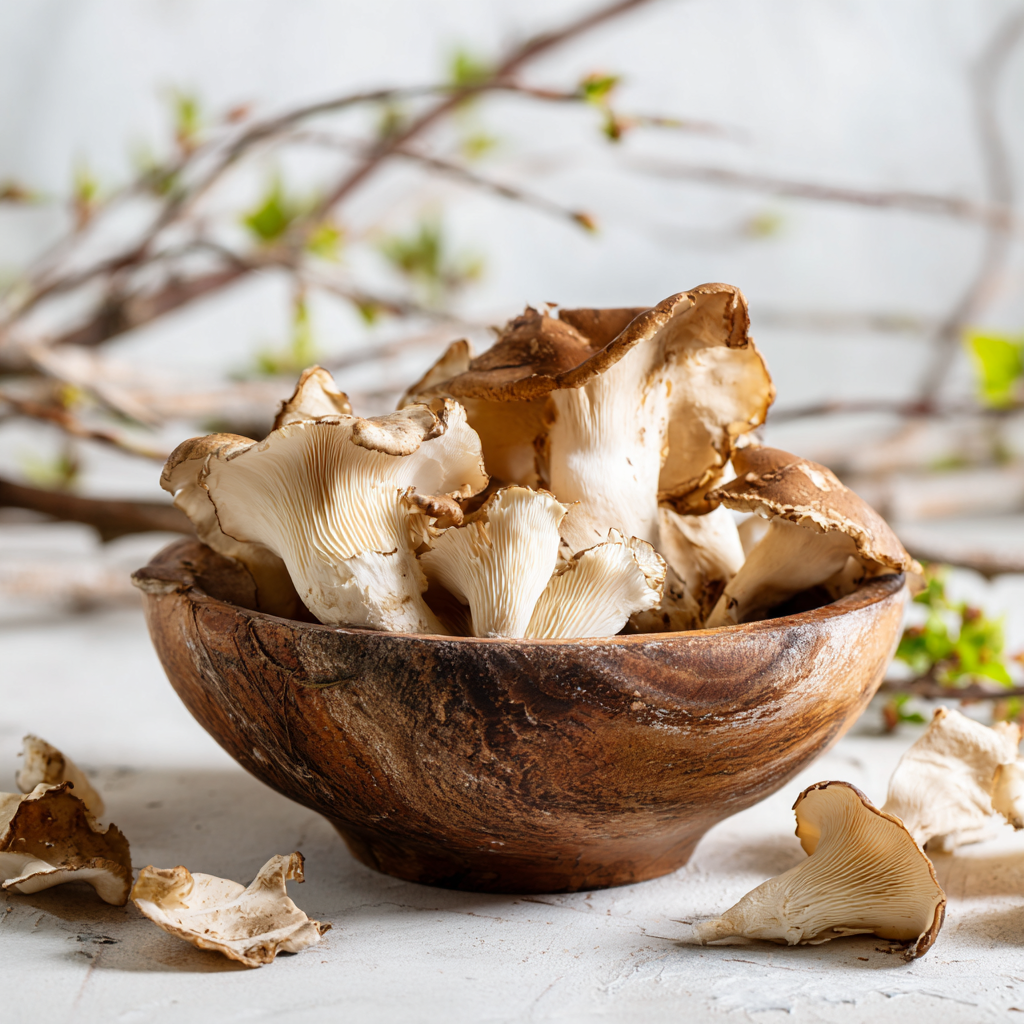
Squirrel hare (Polyporus umbellatus)
The squirrel mushroom (Polyporus umbellatus) is a rare medicinal mushroom that has been used in traditional Chinese medicine (TCM) for centuries. It grows primarily on the roots of oak and beech trees in deciduous forests, where it is traditionally valued for its special constituents.
Botanical characteristics
- Family: Porling relatives (Polyporaceae)
- Growth form: Multi-capped fruiting body with small caps arranged like roof tiles, which together form a bushy structure
- Occurrence: In deciduous forests, often on old oak and beech roots
- Extraction: For food supplements, the use is usually from controlled mycelium cultures or – less frequently – from wild collection
Ingredients
Oak hare extracts contain, among other things:
- Polysaccharides (e.g. beta-glucans) – in the product Skin Hair Nails: approx. 30 mg per daily dose (2 capsules) from 100 mg extract
- Ergosterol (a precursor to vitamin D₂)
- Minerals such as potassium, iron and zinc
- Triterpenes and other secondary plant substances
Traditional and modern use
In TCM, the squirrel is traditionally used to support excretory processes and energy balance.
This information is based on traditional use and is not equivalent to approved health claims.
Modern research focuses particularly on its bioactive components , such as polysaccharides. However, there are currently no approved health claims for squirrel mushroom in the EU.
Scientific studies
- Structural characterization and immunomodulatory activity of a polysaccharide from Polyporus umbellatus. Int. J. Biol. Macromol., 2018.
- Polyporus umbellatus: ethnomedicinal uses and pharmacological potential. J. Ethnopharmacol., 2021.
These sources are intended for scientific classification and not for deriving health-related statements.
Dietary supplement with squirrel extract (advertisement)
Skin, hair, nails – with 100 mg of oak bark extract per daily dose (2 capsules), of which 30 mg are polysaccharides, combined with silicon from bamboo extract and other micronutrients.
A notice:
Dietary supplements are foodstuffs. They are intended to complement a balanced diet and do not replace a varied diet or medical treatment.
Instructions for use
- Dietary supplements are not a substitute for medical diagnosis or therapy.
- If you have any existing medical conditions or are taking medication, you should seek medical advice before use.
Frequently Asked Questions (FAQ)
What is Polyporus umbellatus?
A rare medicinal mushroom from TCM, known in Europe as squirrel mushroom.
How is it won?
Mainly through controlled mycelium cultures, partly through wild collection.
What applications have been handed down?
In TCM it is traditionally used to support excretory processes and energy balance (traditional use, no approved health claims).
Is he safe?
At the recommended dosage, oak hare extract is considered well tolerated.
Can it cure diseases?
No. Dietary supplements are food products and are not intended to treat, cure, or prevent any disease.
Legal notice
This article is intended solely to provide general information about the squirrel and is not a substitute for medical advice.
Dietary supplements are food products. They are not a substitute for a balanced diet or medical treatment.
Transparency notice
The products mentioned in this article refer to products from our own range. We generate revenue from the sale of these products. Disclosures are in accordance with Section 5a of the German Unfair Competition Act (UWG) and Section 3 of the German Commercial Code (HWG).
The plant images used in this article are symbolic representations. They were created with AI support and are for illustrative purposes only. Deviations from the natural representation are possible.
