

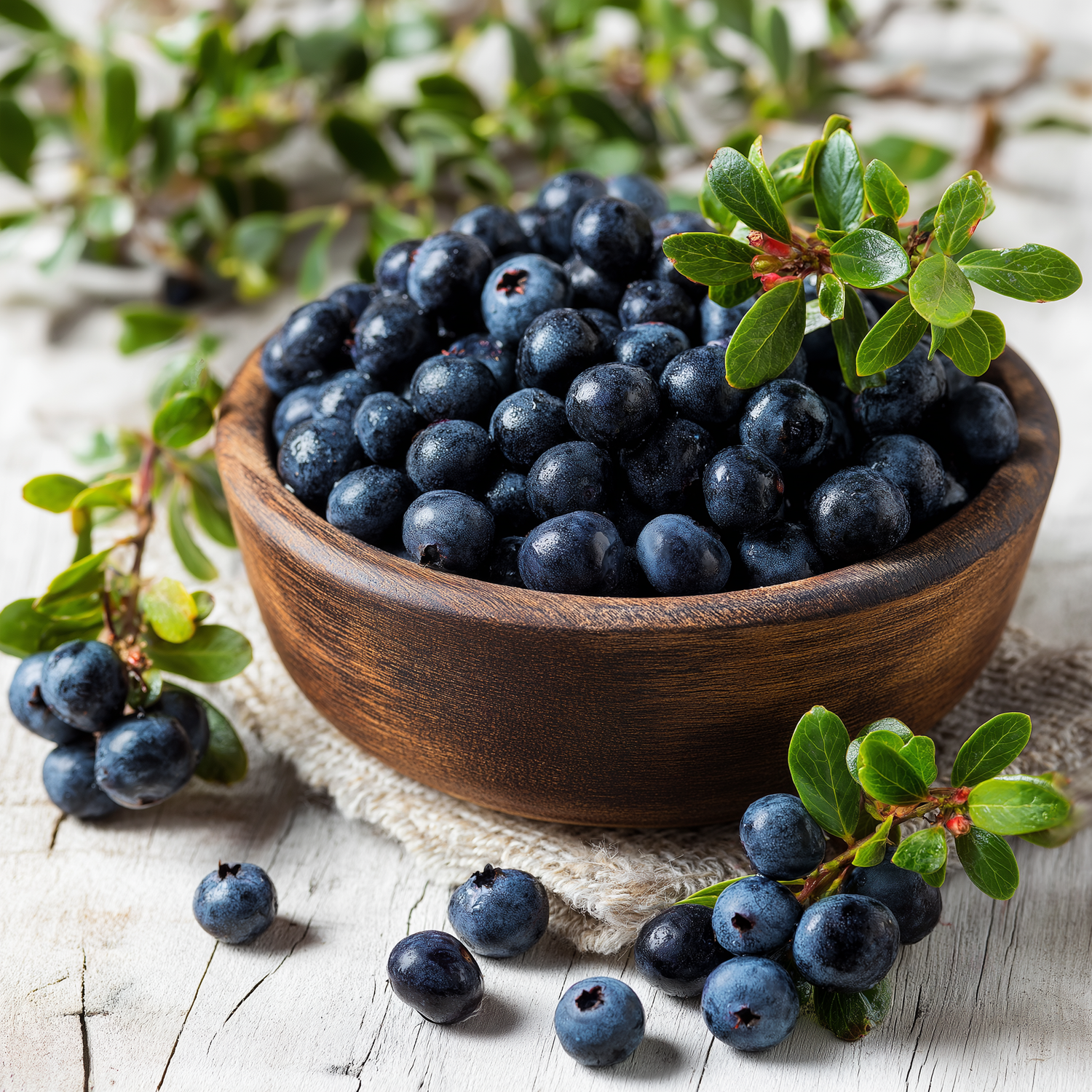
Blueberry extract (Vaccinium myrtillus)
The bilberry (Vaccinium myrtillus) is a wild berry native to Europe and northern Asia. It prefers open forests, moors, and heathlands. In addition to its fruity, tart flavor, it has been valued for centuries both as a food and in traditional herbal medicine.
Botanical characteristics
The blueberry belongs to the heather family (Ericaceae).
- Growth form: Low-growing subshrub, up to approx. 50 cm high
- Fruits: Dark purple berries with dark-colored flesh (unlike cultivated blueberries, which have light flesh)
Ingredients
Standardized blueberry extract contains among other things:
- Anthocyanins (secondary plant substances)
- Polyphenols
- Vitamin C
- Fiber (especially in fruit powder)
Our product Bermyrtill contains 250 mg of blueberry extract per capsule, of which 62.5 mg are anthocyanins (according to the manufacturer).
Traditional use
Blueberries have been traditionally used in European folk medicine:
- for gastrointestinal complaints
- to support vision
- as a general tonic
This information is based on traditional tradition and does not constitute approved health claims .
Modern use (advertising)
Bermyrtill contains high-quality blueberry extract, standardized for anthocyanin content.
Dietary supplement – not a medicine.
Not intended to treat, cure, or prevent any disease.
Scientific studies
- Anthocyanins and Human Health: An In-Depth Review. Molecules, 2019
- Blueberry Supplementation Improves Memory in Older Adults. Journal of Nutritional Biochemistry, 2010
- Safety Assessment of Blueberry Extract in Human Trials. Critical Reviews in Food Science and Nutrition, 2016
These studies are intended solely for general scientific information and should not be construed as health-related advertising .
Instructions for use
- Food supplements are not a substitute for a balanced and varied diet
- Observe recommended dosage
- If you have an existing illness or are taking medication, seek medical advice
Frequently Asked Questions (FAQ)
What is the difference between wild and cultivated blueberries?
Wild blueberries (Vaccinium myrtillus) have dark-colored flesh and generally contain more anthocyanins than cultivated blueberries (Vaccinium corymbosum), whose flesh is light.
How is blueberry extract made?
The berries are gently dried, extracted and often standardized for anthocyanin content.
Can blueberry extract be taken long-term?
It is considered safe at recommended dosages. Long-term use should be discussed with a healthcare professional.
Legal notice
This article is for general information purposes only.
No health claims are made beyond the approved formulations in accordance with EU Regulation (EC) No. 1924/2006.
Dietary supplements are not a substitute for medical advice and are not intended to treat, cure or prevent any disease.
Transparency notice
The products mentioned in this article refer to products from our own range. We generate revenue from the sale of these products. Disclosures are in accordance with Section 5a of the German Unfair Competition Act (UWG) and Section 3 of the German Commercial Code (HWG).
The plant images used in this article are symbolic representations. They were created with AI support and are for illustrative purposes only. Deviations from the natural representation are possible.
