

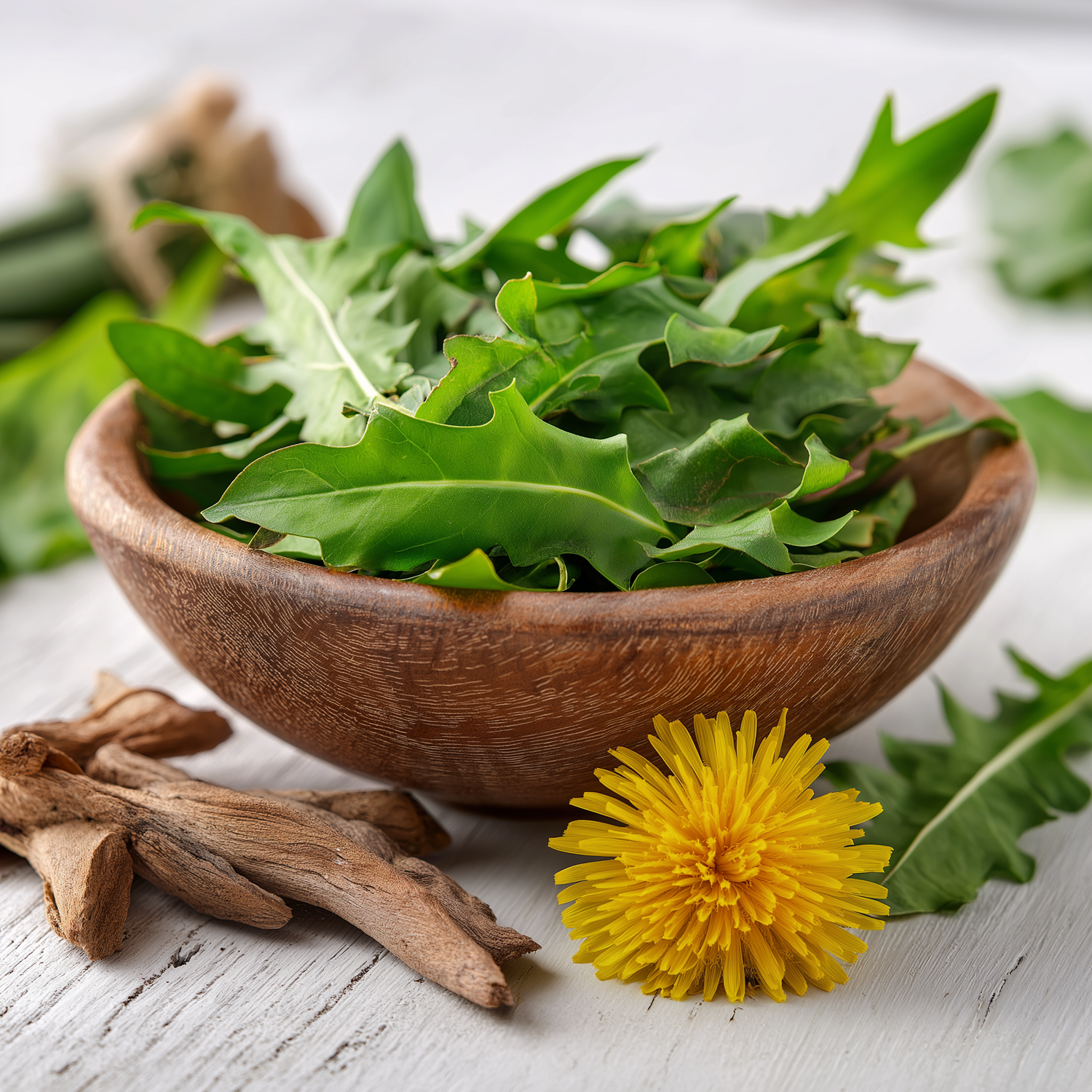
Dandelion (Taraxacum officinale)
Dandelion (Taraxacum officinale) is a widespread wild plant in the daisy family (Asteraceae). In Europe, it can be found in meadows, along roadsides, and in gardens. For centuries, its leaves, flowers, and especially its roots have been used in traditional botany.
Botanical characteristics
- Leaves: Basal, strongly serrated
- Flowers: Bright yellow, typical of daisies
- Seed heads: familiar “dandelions” with parachutes
- Root: Deep taproot, especially important in phytotherapy
Ingredients
The dandelion root contains among other things:
- Inulin (prebiotic fiber)
- Bitter substances (e.g. taraxacin)
- Flavonoids
- Phenolcarboxylic acids
Traditional use
In European botany, dandelion has traditionally been used in dietary applications – particularly to support digestion and excretion.
This information is based on traditional experience and does not constitute approved health claims.
Modern use (advertising)
Today, dandelion – especially as root extract – is a component of dietary supplements containing plant bitter substances or fiber.
Example from our range: RepaHepar contains, among other things, 100 mg of dandelion root extract per daily dose (2 capsules).
Dietary supplement – not a medicine.
Scientific studies (general information)
These studies are intended solely for general scientific information and not as health advertising:
- Jeon H et al. (2019): Inulin-type polysaccharides from dandelion root improve intestinal function. International Journal of Molecular Sciences.
- Noh JR et al. (2016): Effects of dandelion root extract on oxidative stress and inflammation in mice. Food and Chemical Toxicology.
Instructions for use
- Food supplements are not a substitute for a balanced diet
- If you have an existing illness or are taking medication, seek medical advice
- Not recommended for known allergy to daisy family
Frequently Asked Questions (FAQ)
Can you collect dandelions yourself?
Yes, but only in uncontaminated locations. A standardized extract is recommended for reproducible dosages.
Does dandelion have diuretic properties?
Traditionally, this is how it is described. However, there are no approved health claims for it.
Is dandelion suitable for daisy family allergies?
People with allergies to daisies should be cautious and seek medical advice if necessary.
Can dandelion interact with medications?
Yes, for example, with diuretics or blood pressure medications. Consult a medical professional before taking.
Legal notice
This article is for general information purposes only and does not replace medical advice.
No health claims are made beyond the approved formulations in accordance with EU Regulation (EC) No. 1924/2006.
Transparency notice
The products mentioned in this article refer to products from our own range. We generate revenue from the sale of these products. Disclosures are in accordance with Section 5a of the German Unfair Competition Act (UWG) and Section 3 of the German Commercial Code (HWG).
The plant images used in this article are symbolic representations. They were created with AI support and are for illustrative purposes only. Deviations from the natural representation are possible.
