

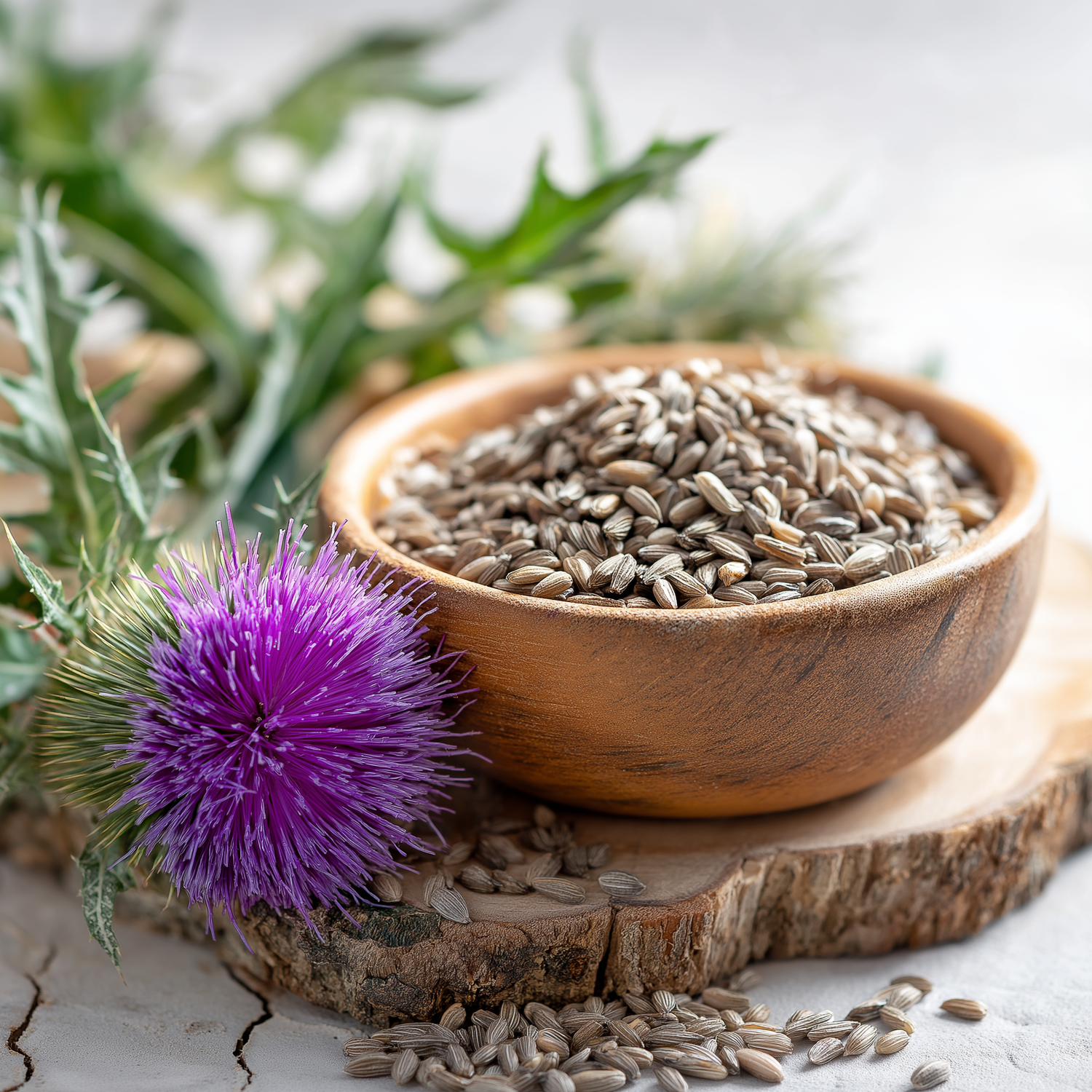
Milk thistle (Silybum marianum)
The milk thistle (Silybum marianum) is a striking plant from the daisy family (Asteraceae). It originates from the Mediterranean region and has been used in traditional botany for centuries. It owes its name to a legend: the white leaf veins are said to come from a drop of Mary's milk.
Botanical characteristics
- Annual to biennial plant, up to 1.5 m tall
- Large, spiky leaves with white marbling
- Strong purple flower heads
- The fruits (seeds) are mainly used for dietary supplements because they contain the silymarin complex
Ingredients
The seeds of milk thistle contain, among other things:
- Silymarin complex (including silibinin, silychristin, silydianin)
- Flavonoids
- Bitter substances
- Fats and proteins
Note: The silymarin complex
has been scientifically well researched, but there are currently no
health claims for milk thistle approved.
Traditional use
In medieval monastic medicine, milk thistle was considered a plant to support the liver. Even today, it is traditionally used in European botany.
These instructions are based on traditional experience and are not approved health claims.
Modern use (advertising)
Today, milk thistle is used in many dietary supplements, mostly as a standardized extract with a defined silymarin content.
Example from our range: RepaHepar contains per daily dose (4 capsules):
- 150 mg milk thistle seed extract, of which 120 mg silymarin
Dietary supplement – not a medicine.
Scientific studies (general information)
These studies are intended solely for general scientific information:
- Schulter KD et al. (2020): Protective effect of silymarin on liver tissue and function – a review. J Clin Exp Hepatol.
- Federico A. et al. (2017): The role of silymarin in liver diseases. Dig Liver Dis.
Instructions for use
- Dietary supplements do not replace a varied diet
- Not intended to treat, cure or prevent any disease
- If you have existing liver disease or are taking medication, seek medical advice
- Not suitable for people with asteraceae allergy
Frequently Asked Questions (FAQ)
What is silymarin?
A plant substance complex from the seeds of milk thistle, consisting of flavonolignans such as silibinin.
Is milk thistle suitable for long-term use?
Traditionally yes, but medical advice is recommended if taking it for a longer period of time.
Can milk thistle have side effects?
Gastrointestinal complaints or allergic reactions may rarely occur.
Is milk thistle vegan?
Yes, as long as the capsule shell is plant-based (e.g. cellulose).
Powder or extract – which is better?
Extracts are standardized to a defined content of ingredients and allow for more precise dosing.
Legal notice
This article is for general information purposes only and does not replace medical advice.
No health claims are made beyond the approved formulations in accordance with EU Regulation (EC) No. 1924/2006.
Transparency notice
The products mentioned in this article refer to products from our own product range. We generate income through the sale of these products.
Information according to § 5a UWG and § 3 HWG.
